By Christian Mikkelsen
November 23, 2026
Hydrogen has three jobs in the maritime sector. It can power vessels through fuel cells. It can power the equipment that moves cargo around ports. And as ammonia, it can cross oceans as both cargo and fuel. This post covers what has happened in each area this year and picks up where our earlier posts on marine transportation and ports left off.
In July, FCHEA’s Circuits webinar, Molecules in Motion: Hydrogen’s Role Moving the Maritime Sector, looked at all three of these roles for hydrogen, with FCHEA members highlighting key projects and demonstrations, and delving into the benefits hydrogen brings on board.
In addition to the companies that participated in the webinar, other FCHEA members are active in all three areas, and the sections below follow each in turn.
Fuel Cells on the Water
In June, FCHEA member PowerCell Group, a Swedish fuel cell developer, announced an order to supply fuel cell systems for two liquid hydrogen-powered cargo ships being built by Norwegian company LH2 Shipping. The contract is worth ~$5.5 million and covers 4 megawatts (MW) of installed power from PowerCell’s Marine System 225 fuel cell. The vessels are designed for short-sea routes in the North Sea, and deliveries are scheduled to be complete by 2028. Marine System 225 holds marine type approval from classification societies Lloyd’s Register and RINA, and PowerCell plans to add DNV approval as part of the project. PowerCell’s CEO said the industry is still early in its energy transition, but the pace is clearly increasing.
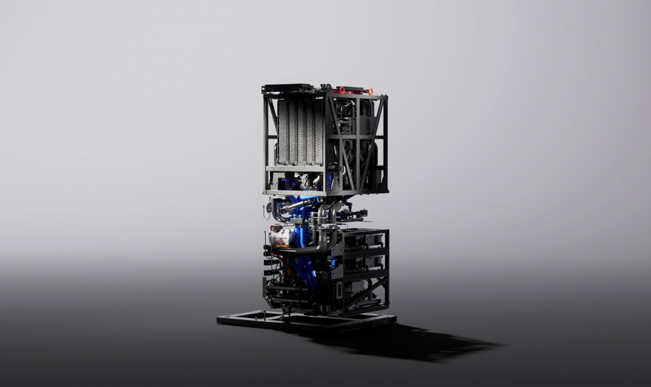
Figure 1. PowerCell Group marine fuel cell system. Source: PowerCell Group.
Public funding is backing the next steps. In January, PowerCell joined GAMMA, a Horizon Europe project valued at about $20 million to show that fuel cells can replace fossil-fueled auxiliary generators on large ocean-going vessels. PowerCell is contributing a 1 MW-class system that runs on hydrogen produced onboard from green methanol and ammonia. In February, the company joined MiNaMi, an EU-funded project valued at about US$8 million (€7 million) to develop Europe’s first megawatt-scale PEM fuel cell system for maritime use. In August, PowerCell received an order of ~$2.3 million from the German Aerospace Center (DLR) for a system at its maritime test facilities in Kiel, part of the German zero4cruise project. The system pairs two Marine System 225 units with methanol reformers, with delivery planned for the fourth quarter of 2026.
FCHEA member Toyota is part of a new passenger vessel project in Japan. In June, shipping company NYK, engine maker Yanmar Power Solutions, and energy company ENEOS announced that a new dining cruise ship, scheduled to enter service in Tokyo in 2027, will run on a hydrogen fuel cell system. Yanmar is designing the system, Toyota is providing the hydrogen storage modules, and ENEOS will produce and supply the hydrogen from refueling stations, primarily in Tokyo. The vessel is about 48 meters long and will succeed the NYK Group’s Lady Crystal.
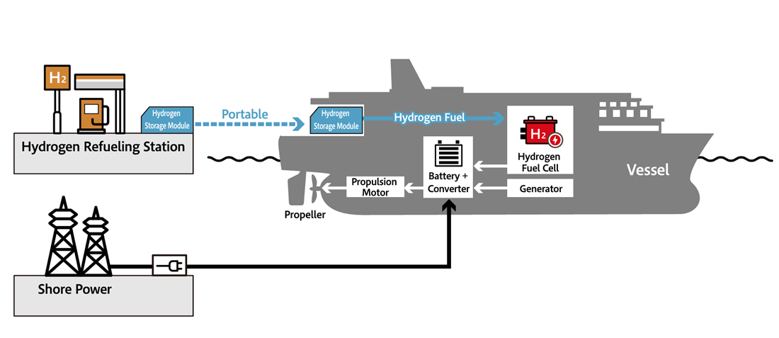
Figure 2. Concept diagram of the hydrogen fuel cell system for the new Tokyo dining cruise ship, with Toyota hydrogen storage modules. Source: NYK, Yanmar Power Solutions, and ENEOS.
Hydrogen at the Port
On land, Nuvera is a great example of a fuel cell company powering port equipment. Its fuel cell engines run a Hyster top-pick container handler at the Port of Los Angeles, which Nuvera described in 2022 as a first-of-its-kind pilot at one of the world’s busiest ports. The handler uses two E-45 fuel cell engines alongside a battery and was expected to refuel in about 15 minutes and run for eight to ten hours at a time. In Europe, Nuvera engines were selected for a terminal tractor and an empty container handler at HHLA’s Container Terminal Tollerort in Hamburg, and for a reach-stacking container handler at the Port of Valencia under the EU-funded H2PORTS pilot project. As of early 2025, Nuvera listed deployments of toploaders, reachstackers, and terminal tractors at the Ports of Los Angeles, Valencia, and Hamburg, with more planned.
Nuvera has added two more port deployments this fall. In September, Hyster delivered the United Kingdom’s first hydrogen fuel cell-powered ReachStacker to the Port of Tilbury in Essex. It is powered by a Nuvera 60 kW fuel cell engine supporting a 130 kWh lithium-ion battery and is designed to run a full 12-hour shift. In early October, Hyster delivered a similar ReachStacker to Rotterdam Shortsea Terminals in the Netherlands, where it will handle 45-foot containers as part of a five-year, EU-supported hydrogen innovation project for port logistics.
Nuvera also points out that hydrogen-powered equipment can handle demanding port duty cycles without major charging infrastructure, substation upgrades, or long recharging downtime. Its HydroCharge mobile fuel cell generator supplies AC power and Level 3 fast charging for battery electric equipment arriving at ports.
Liquid hydrogen supply is also taking shape at ports. According to the Port of Rotterdam, the new liquid hydrogen plant in the port from FCHEA member Air Products, a global industrial gases company, was more than 65 percent complete as of April and is on track to be operational in 2027. It will be the largest liquid hydrogen facility in Europe, with maritime among the sectors it will serve.
Ammonia Carries Hydrogen Across Oceans
Ammonia is one way hydrogen travels. Hydrogen can be combined with nitrogen to make ammonia, which acts as a hydrogen energy carrier: it can be used directly as a fuel or converted back into hydrogen where it is needed. For long-distance shipping, ammonia is often easier to handle than hydrogen itself. It liquefies at about −33°C, while hydrogen must be cooled to about −253°C, and ammonia is already produced, stored, and shipped around the world for fertilizer, so tanks, ports, and vessels for it already exist. That is the idea behind the NEOM Green Hydrogen Project in Saudi Arabia, where Air Products is the exclusive off taker. The project is under construction and is designed to convert renewable hydrogen into green ammonia that can move by conventional ammonia vessel instead of as hydrogen gas. Air Products reported on November 5 that construction is in final completion and commissioning has begun, and it expects the plant to be fully operational in the second half of 2027. As we covered in our September post on fertilizer, Air Products finalized a marketing and distribution agreement with Yara, a Norwegian fertilizer company, in July for NEOM ammonia that is not converted back into hydrogen for European customers, moving it through Yara’s existing global supply chain.
FCHEA member JERA, Japan’s largest power generation company, is lining up the ships to carry its ammonia. In June, JERA signed time charter agreements with shipping companies MOL and NYK for four very large gas carriers, described as the first long-term deployment of VLGC-size vessels built specifically for ammonia transport. JERA plans to export about 500,000 metric tons of ammonia a year from the Blue Point project in Louisiana. In October, JERA also signed a binding agreement with Indian green ammonia developer AM Green to buy about 70,000 metric tons of green ammonia a year for five years from AM Green’s Kakinada facility in India, which is planned to be commissioned by 2028 to 2029. The ammonia will be delivered to a receiving terminal being developed next to JERA’s Hekinan Thermal Power Station in Aichi Prefecture, Japan, and is intended primarily to fuel ammonia-powered car carriers.
Ammonia is also a promising fuel feedstock to create hydrogen for fuel cells. PowerCell’s GAMMA project, described above, will run on hydrogen produced onboard from green methanol and ammonia. Separately, in November, PowerCell announced it received a $1.5 million order to supply its Marine System 225 fuel cell systems and engineering services to H2SITE, an industrial technology company based in Spain, for a project that will develop and validate an ammonia-to-power solution for commercial maritime applications.
The project, HydraNord Power, will use H2SITE’s membrane reactor technology to convert ammonia into high purity hydrogen, which will be used in PowerCell’s fuel cells to generate electricity, developing a modular solution that can be adapted to different vessel types and power requirements.
Looking Ahead
Fuel cells aboard ships, hydrogen-powered equipment at ports, and ammonia in tanks are three different routes into the same sector, and each now has orders, deployments, or supply agreements behind it. FCHEA members are supplying the technology and the fuel at each step. To hear from the speakers directly, watch the recording of Molecules in Motion.