May 18, 2026
by Jennifer Gangi
Fuel cells and hydrogen technologies have a long and proven history fueling innovations in aerospace, with the National Aeronautics and Space Administration (NASA) first launching fuel cells into our energy orbit more than 60 years ago. Continued R&D, technology validations, demonstrations, product innovations, and real-world orders and deployments across NASA and several other branches of the U.S. military, and private sector companies in the decades since have brought the industry back to earth. Today, there are fuel cell and hydrogen-powered airplanes and Vertical Take-Off and Landing (VTOL) aircraft in development, and fuel cell drones/unmanned aerial vehicles (UAV) commercially available, boosting the industry to new heights.
In FCHEA’s Catalyst Blog series, we’ve covered NASA’s activities and fuel cell airplanes, so this one will provide an update on FCHEA member activity with UAVs and VTOLs.
The U.S. miliary has supported R&D and deployment efforts in fuel cell and hydrogen for UAVs for more than 20 years, but outside of the military, there are numerous commercial and recreational applications for UAVs that are driving the sector’s growth. This includes medical/emergency relief, surveillance, infrastructure inspection, fire/land management, mapping, photography, search and rescue, and even parcel delivery, among others.
As with other applications, fuel cells offer a range of benefits that are appealing to the military and private sector as a power option for drones and other unmanned vehicles.
Fuel cells generate electricity with low to zero emissions, operate quietly, are lighter and last longer than batteries, and can operate on a variety of fuels and feedstocks, including hydrogen, renewable fuels, and traditional hydrocarbon fuels like natural gas, propane, kerosene and JP8. They are also extremely efficient with high power density. For UAVs, all of these benefits result in longer operational life and extended flight times – covering more area on less fuel. For VTOLs, it also means you don’t have to sacrifice payload capacity.
FCHEA member HyAxiom is part of the Doosan Group, a Korean multi-national company that focuses on clean energy technologies and applications, among other interests. Another company under the Doosan umbrella, Doosan Mobility Innovation (DMI), offers a full fuel cell and hydrogen UAV product portfolio. In 2019, DMI’s DS30 fuel cell drone completed a successful 43-mile test flight over open water between the U.S. Virgin Islands of St. Croix and St. Thomas, flying for one hour and 43 minutes, completing the flight with 30 minutes’ worth of hydrogen fuel left in the tank. The company won the “Best of Innovation” award in the Drones and Unmanned Systems category at the 2020 Consumer Electronics Show (CES) for its DS30 drone.
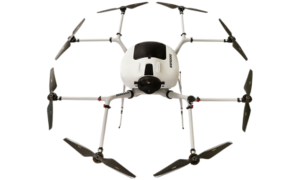
DMI DS30 drone
Swedish fuel cell manufacturer and FCHEA member PowerCell Group, is collaborating with Australian-based AMSL Aero to integrate its fuel cell into a VTOL aircraft. The companies have started a concept study and then will undergo rigorous ground testing, followed by detailed flight testing to validate the system in actual operating conditions. AMSL Aero’s hydrogen-electric VTOL is designed to have a range of 1,000 kilometers (km), top speeds of 300 km/h, a payload capacity of 500 kilograms, and take only 10 minutes to refuel.
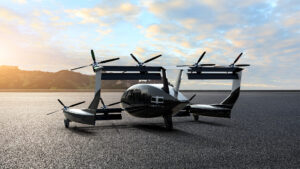
PowerCell/AMSL Aero hydrogen eVOTL
Fueling for Flights
For the current fuel cell UAV/drone/VTOL landscape, most are using hydrogen tanks stored on board, which also weigh significantly less than batteries and other conventional fuels. A lot of the R&D, testing, and demonstration in this sector is geared towards increasing the flight time duration o by increasing storage capacity, reducing weight of the UAV and tanks, and different forms of hydrogen that can be utilized – gas, liquid, or solid form.
Currently, fuel cell drones are primarily using compressed hydrogen, typically stored at pressures ranging from 350-700 bar (5,000-10,000 psi), similar to fuel cell-powered forklifts, passenger vehicles, and buses. Lightweight, composite wrapped or Type IV polymer tanks are used for onboard fuel storage.
FCHEA member Luxfer Gas Cylinders offers hydrogen storage cylinders for this sector, and is working with several companies to integrate its storage vessels into fuel cell-powered drones and aircraft.
H2MOF, another FCHEA member, offers solid-state hydrogen storage technology for UAV applications, leveraging Metal-Organic Frameworks (MOFs), Covalent Organic Frameworks (COFs), and other advanced porous materials to store hydrogen at low pressure and ambient temperature.
FCHEA member AIRCO has introduced its “MAD” Fuel System, a deployable, containerized technology platform that converts carbon dioxide and hydrogen into fully formulated, drop-in ready synthetic fuels, including jet fuel and sustainable aviation fuel (SAF), enabling production directly at the point of use. The company is working with the Department of the Air Force (DAF), the Air Force Research Laboratory, and other military and governmental offices through several funding awards. As the MAD Fuel System is mobile, it can provide fuel for drones as well as larger manned vehicles and uses much easier and safer than today’s methods.
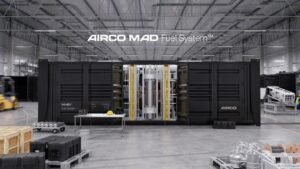
AIRCO’s MAD Fuel System
FCHEA Activities
FCHEA, as the national industry association, is heavily involved in hydrogen and fuel cell codes, standards, and regulations development and tracking for our members. For the aviation sector, FCHEA’s Technical and Regulatory Working Group is following the progress of standard IEC 25009: Unmanned aircraft systems – General requirements and test methods for hydrogen fuel gas pipes of gaseous fuel cell powered UAV. We are also tracking FAA airworthiness certification considerations for UAVs above 55 lbs, including potential hydrogen and fuel cell applicability under 14 CFR Part 21 certification procedures. FCHEA also successfully advocated for hydrogen R&D and certification programs in the FAA Reauthorization Act of 2024.
As companies continue to make innovations and advancements in lighter materials and systems for fuel cells, UAV components, and storage vessels, as well as in different hydrogen storage technologies and product offerings, the benefits and uses for fuel cell and hydrogen-powered drones and aircraft will keep elevating and expanding into new commercial markets.