June 1, 2026
by Jennifer Gangi
If there was one word to describe fuel cells, it should be “flexible.” Fuel cells offer flexibility in a myriad of ways. Flexible in the fuels it can utilize to generate power – hydrogen, natural gas, methanol, biogas, to name just a few. Flexible in its technology makeup – proton exchange membrane (PEM), solid oxide, molten carbonate, phosphoric acid, among others. And most importantly, to a range of industries that deploy them, flexibility in size and siting. Fuel cells come in all sizes – from sub watt to megawatt (MW), which can be connected to other units to increase to multi-MW and higher.
Today there are thousands of large-scale fuel cell systems generating efficient, reliable power to a range of facilities – data centers, hospitals, retail sites, universities, company headquarters, and more. In addition, tens of thousands of fuel cells have been installed throughout the world to provide backup or continuous power to telecommunications networks, railroads, utility substations, and traffic infrastructure.
While collectively these fuel cell systems represent a range of technologies, fuels, sizes, configurations, and manufacturers, they are all considered ‘stationary’ fuel cells in that they are installed onsite to provide backup or primary power to a location.
Going back to flexibility, FCHEA members are taking that to heart, offering fuel cell and hydrogen products that can be easily transported and sited to provide quiet, seamless power where needed – construction sites, electric vehicle (EV) charging stations, concerts/events, and emergency response situations, among other uses. This flexibility to bring electricity with you, without the noise or emissions from diesel generators, is opening up new opportunities for fuel cells and energy users.
Renewable Innovations, based in Utah, has a diverse portfolio of offerings, including the MPG Hydrogen Mobile Power Generator, which has up to two 80-kilowatt (kW) fuel cell(s) and 40 to 60 kilogram (kgs) hydrogen tanks, to provide mobile power where needed. The company also offers the Mobile Energy Command – Hydrogen Powered EV Charging (MEC-H2EV) with much more fuel cell power – up to 750 kW – to ensure the lights never go out, wherever you are. They can also integrate a 180 kW RAPID EV charging station on the back of the MPG to recharge an EV on the go.
The MEC-H2EV was a critical component of a microgrid system that kept the participants of the Rebelle Rally, a ten-day, 2,000 kilometer, off-road, all-female race. The MEC-H2EV generated power for basecamp which included inside and outside lights, internet and satellite systems, and amenities for racers as well as showers, kitchen equipment, and anything else that needs electricity in the middle of the desert. To showcase the awards ceremony on a big jumbo screen, the hydrogen generated from the MEC-H2EV was used by another FCHEA member, Toyota’s TRD Fuel Cell Generator Tundra to power some of the screens, lighting and sound equipment.

Renewable Innovations’ MEC-H2EV at the Rebelle Rally
The Toyota Racing Development (TRD) Fuel Cell Generator Tundra pickup truck integrates Toyota’s fuel cell systems, same ones used in its Mirai fuel cell electric vehicle (FCEV) and stacks them in the bed of the truck, basically transforming it into a mobile power generator. Toyota has demonstrated the vehicle at various events – highlighting the quiet operation of the fuel cell as a key benefit, especially at outdoor venues.
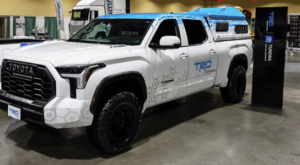
Toyota Tundra with fuel cell generator
Nuvera, a subsidiary of Hyster-Yale Materials Handling, Inc., has rolled out the HydroCharge™, a mobile fuel cell system that can supply on-demand, zero-emission, AC and DC power for a range of applications, including EV charging.
The HydroCharge™ includes a 60 kW Nuvera fuel cell and attaches to a vehicle via a heavy-duty steel trailer. The system weighs less than 10,000 pounds, so it is easy to transport and doesn’t require a commercial driver’s license to do so. The system was selected by the Massachusetts Clean Energy Center (MassCEC) as part of its Medium- and Heavy-Duty Mobile Charging Solutions Program.
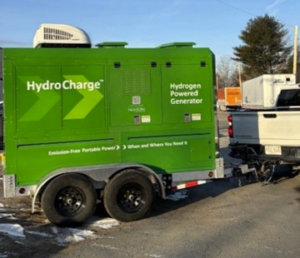
Nuvera HydroCharge™
For the first of that program’s four deployments, Nuvera is supplying a HydroCharge™ to SC Energy, which will attach it to an electric box truck used to transport the company’s insulation materials to sites across Massachusetts.
The ability to generate electricity with quiet operation and zero emissions makes fuel cells an attractive option for power generation. The flexibility of being able to quickly transport, set up, and utilize the fuel cell system onsite, wherever that site may be, makes them an invaluable part of the team.