February 2, 2026
The fuel cell and hydrogen industry wouldn’t be where it was today without the decades of Research & Development (R&D) and out-of-this world deployments from the National Aeronautics and Space Administration (NASA). Fuel cells and hydrogen powered the Gemini, Apollo, and Shuttle missions, as far back as 60 years ago, but NASA is more than an early adopter – the agency is a key partner and customer. The fuel cell technologies that helped man travel to space have developed into commercial systems used on Earth for a range of market sectors.
Today, NASA still uses liquid hydrogen to fuel rocket engines – it is extremely cold and requires cryogenic tanks to store. Earlier this year, FCHEA member Air Products delivered more than 730,000 gallons of liquid hydrogen, over 50 trailer loads, to NASA’s Kennedy Space Center in Merritt Island, Florida, where NASA houses the “world’s largest liquid hydrogen tank” – a 90’x83’ sphere. The hydrogen will be used for NASA’s Artemis Moon missions.
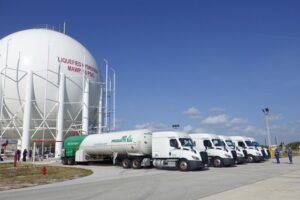
In November, NASA selected Air Products to supply liquid hydrogen to both Kennedy Space Center and Cape Canaveral Space Force Station in Florida, as well as Marshall Space Flight Center in Huntsville, Alabama and Stennis Space Center in Bay St. Louis, Mississippi. The contract is worth approximately $144.4 million for 36.5 million pounds of hydrogen.
NASA also entered into a $2.8 million contract with FCHEA member Plug Power to deliver up to approximately 480,000 pounds of liquid hydrogen to two facilities in Ohio – the Glenn Research Center in Cleveland and at Neil A. Armstrong Test Facility in Sandusky.
As the industry is still looking for a firm foundation on the ground in the current political climate, NASA’s continued investment and commitment to hydrogen is helping prove that the sky is the limit when it comes to its potential to fuel our most critical missions.