By Tobias Hanson
February 24, 2026
Hydrogen-powered forklifts are becoming an increasingly attractive option for warehouse and distribution centers due to several operational and economic advantages. With refueling that takes just minutes, they help boost labor efficiency and keep fleets moving. They also free up valuable floor space by eliminating the need for large charging rooms, offer more predictable energy costs compared to fluctuating electricity rates, and support companies striving to meet lower emissions requirements.
U.S. Deployments
The United States is a leader in global adoption of hydrogen forklifts. Early adopters include large retailers, grocers, manufacturers, and logistics companies that operate warehouse fleets. More recently, major companies have greatly expanded their fleets.
FCHEA member Plug Power has been at the forefront of the hydrogen fuel cell deployment. Plug Power began developing fuel cells for forklifts around 2007 and is today a market leader. According to the company, it has deployed more than 60,000 fuel cell systems and over 180 hydrogen fueling stations worldwide. In the material handling sector, Plug Power’s customers include major retailers such as Walmart, Amazon, Ace Hardware), manufacturers such as BMW and Bridgestone, and logistics companies like FedEx and Sysco. Walmart and Amazon have been Plug customers for many years and continue to expand their hydrogen forklift fleets. These systems have been operating in warehouses for nearly two decades and continue to place new orders as their operations grow.
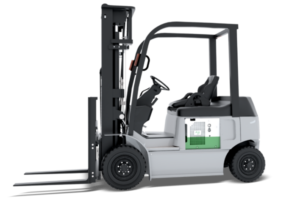
Recently, Plug announced the successful deployment of its GenDrive hydrogen fuel cell systems and GenFuel hydrogen infrastructure at Floor & Decor’s Frederickson, Washington, distribution center. Plug stated it has equipped Floor & Decor’s facility with 77 pieces of material handling equipment as well as a 10,000-gallon liquid hydrogen storage tank, vaporizers, compressors and a high-capacity dispensing system designed for high-throughput operations.
Source: Plug
Plug also recently announced a partnership with Southwire, a North American manufacturer of wire and cable, to implement a clean hydrogen ecosystem at its new distribution site in Dallas-Fort Worth, Texas. Under the agreement, Plug will supply more than 50 hydrogen-powered forklifts, equipped with GenDrive fuel cells, and a fueling station featuring four GenFuel dispensers. Plug has hydrogen production facilities in Georgia, Tennessee, and Louisiana, generating 39 tons per day collectively to support forklift deployments across the region.
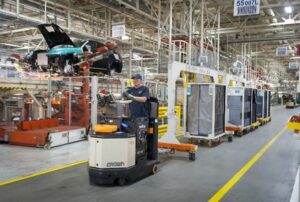
Another early adopter is FCHEA member BMW, which partnered with the U.S. Department of Energy (DOE), Ameresco, Gas Technology Institute, and the South Carolina Research Authority to use Plug fuel cells to power more than 700 units of tuggers and forklifts at its manufacturing plant in Greer, South Carolina.
Source: U.S. DOE
Another FCHEA member, Nuvera, has been deploying hydrogen fuel cell forklifts through its parent company, Hyster-Yale. Most recently, a fuel cell–powered Hyster top-pick container handler equipped with two Nuvera E-45 fuel cell engines was deployed at the Port of Los Angeles in Long Beach, California. This first-of-its-kind machine is part of a project funded by the California Air Resources Board (CARB) and managed by FCHEA member Center for Transportation and the Environment (CTE).
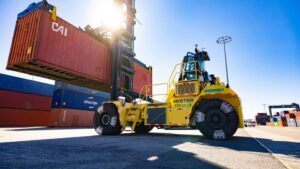
Source: Hyster-Yale
Hydrogen Forklift Deployments Go Global
BMW has been moving towards adopting more hydrogen fuel cell forklifts in its operations overseas. Recently, BMW announced plans to gradually transition from electric power to hydrogen propulsion forklifts by 2030 at its plant in Regensburg, Germany. BMW Group aims to see components delivered to all production areas by hydrogen-powered tugger trains and forklifts.
This year, STEF Group, a European transport and logistics services provider for temperature-controlled food products, launched two hydrogen projects with Toyota Material Handling Europe and Plug Power. STEF is incorporating green hydrogen to power its forklift at two of its sites: a transport platform in Athis-Mons, close to Paris, France, and a logistics warehouse in Torrejón de Ardoz, near Madrid, Spain.
Hydrogen forklifts are far from a new concept. For years, they’ve been delivering cleaner, more efficient performance in warehouses, with major operators like Amazon and Walmart relying on tens of thousands of fuel cell units to keep their logistics moving. With continued adoption both in the U.S. and abroad, hydrogen-powered material handling will remain a trusted, scalable solution supporting cleaner and more efficient industrial operations for years to come.